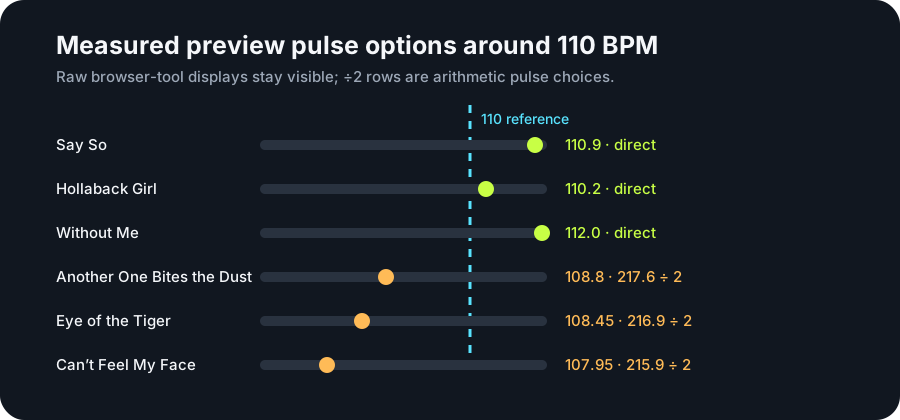
These six specific recording previews produced a working pulse from 107.95 to 112.0 BPM in our browser checks. Three are direct analyzer displays; three are transparent half-time calculations from faster raw displays. These are excerpt observations, not claims that a full song is exactly 110 BPM.
Raw BPM Finder displays and the pulse level used for this shortlist
The editorial window is 107.5–112.5 BPM around the 110 reference. It is a selection rule, not a measured error margin. Half-time values preserve the raw display before dividing by two. Download the complete nine-candidate screening record.
Keep the pulse level visible
A single excerpt can support more than one musically sensible count. The analyzer followed a faster recurring event in the “Another One Bites the Dust” preview and displayed 217.6 BPM. Counting every other event gives 217.6 ÷ 2 = 108.8 BPM. The division is exact for that displayed value, but choosing the slower pulse remains a listening decision.
The three direct rows need no pulse conversion. “Say So” displayed 110.9 BPM, “Hollaback Girl” displayed 110.2, and “Without Me” displayed 112.0. We keep the tenths instead of rounding every result to 110, so the page shows what the tool actually returned.
Original comparison: dots show the working pulse used for the shortlist; labels state whether it came directly from the analyzer or from raw BPM divided by two.
What the screening rejected
The same run checked three other named previews. “Can’t Stop the Feeling!” displayed 112.6 BPM, just outside the stated window. “Stronger” displayed 104.0 BPM. “Pon de Replay” displayed 198.1 BPM, whose half-time arithmetic is 99.05 BPM. Those results stay in the downloadable record instead of being silently rounded or relabeled.
This rule makes the list reproducible: a row must identify one catalog record, preserve the analyzer’s one-decimal output, and show any pulse conversion. A song title by itself is not enough because another edit, live version, or preview excerpt can produce a different reading.
Use 110 BPM for timing, not for a pace promise
At the reference rate, one beat interval is 60 ÷ 110 = 0.5455 seconds. At the measured 110.2 BPM for “Hollaback Girl,” it is 60 ÷ 110.2 = 0.5445 seconds. If a runner takes one step per counted beat, that choice is 110.2 steps per minute; two steps per beat would be 220.4 steps per minute.
Neither number gives a running pace by itself. Pace also requires measured distance per step. With step length L meters, minutes per kilometer = 1,000 ÷ (110.2 × L) for one step per beat. We did not measure a runner’s step length, so this page does not convert the music reading into a personal pace.
Questions about the shortlist
Are all six previews measured directly at about 110 BPM?
No. Three raw displays are close to 110. The other three raw displays are close to 216–218 BPM and appear here only with their clearly labeled half-time arithmetic.
Are these full-song tempo certifications?
No. Each observation belongs to the available catalog preview file for the linked recording. Preview start position, full-track stability, intended beat level, and analyzer error margin were not established.
Why include values such as 107.95 instead of rounding to 108 or 110?
The value 107.95 is the exact arithmetic result of the displayed 215.9 divided by two. Keeping it visible prevents a rounded label from replacing the underlying measurement.
Can I test another version?
Yes. Load a lawful local audio file into the BPM Finder, then compare its raw display with the pulse you hear. The selected audio is analyzed in your browser.
Sources and measurement conditions
On October 16, 2026 in Shanghai time, each linked public Deezer preview was fetched into memory and supplied through the local file chooser to the unmodified Tap BPM Now BPM Finder in Chrome. The tool reported “Analysis complete” and displayed the raw one-decimal readings recorded here. No audio or lyrics are hosted on this page.
The catalog preview files were approximately thirty seconds long, but their start positions inside the complete recordings were not stated. The test did not establish full-song tempo, intended pulse level, preview-to-preview repeatability, or a measurement error margin. The screening CSV preserves all nine source records, UTC measurement times, raw displays, calculations, and inclusion decisions.