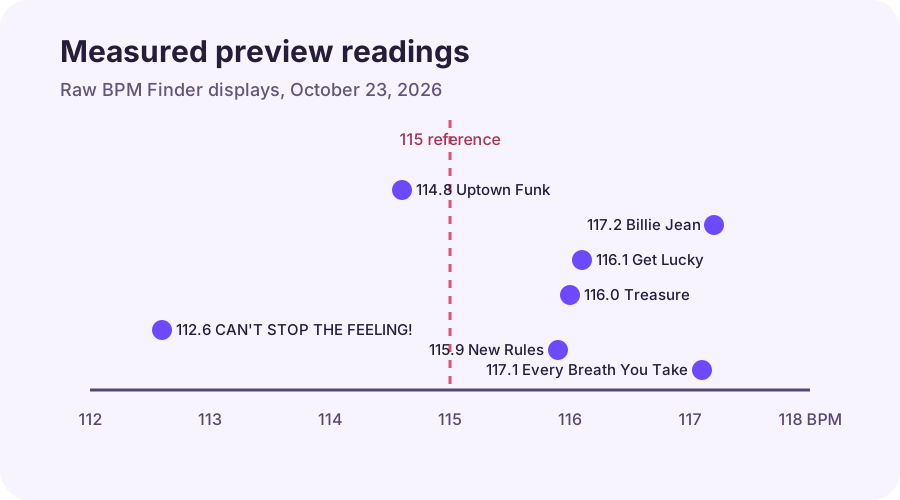
These exact catalog previews produced raw BPM Finder displays from 112.6 to 117.2 BPM. The list keeps every one-decimal result, version label, source link, and measurement date visible instead of rounding each recording to 115.
Exact catalog version and raw browser-tool reading
The readings form a range, not seven identical labels
The closest raw result to the target is 114.8 BPM, while the full accepted set spans 112.6 to 117.2 BPM. The difference between those endpoints is 4.6 BPM. Keeping that spread visible prevents the page title from replacing what the detector actually displayed.
Original data graphic showing every accepted raw display against the 115 BPM reference.
A BPM difference becomes a measurable interval difference
At 115.9 BPM, one beat lasts 60,000 / 115.9 = 517.7 milliseconds. At the slow edge, 112.6 BPM gives 532.9 milliseconds per beat; at the fast edge, 117.2 BPM gives 511.9 milliseconds. The endpoint interval difference is 21.0 milliseconds.
This conversion can set a metronome, edit grid, or practice loop. It does not prove that every section of the complete recording holds the same pulse.
The evidence is tied to the exact preview and date
Each row identifies the catalog track that supplied the preview and the date its complete available preview was tested. The catalog did not state where that excerpt begins inside the full recording, so the evidence applies to the accessible preview rather than an untested full track.
No audio or lyrics are hosted here. A studio master, radio edit, soundtrack listing, remaster, live performance, or different analysis section can produce another display.
The rejected candidates define the page boundary
The same run checked sixteen catalog matches. Thriller displayed 118.2 BPM, Flowers 118.1, Smells Like Teen Spirit 118.1, Moves Like Jagger 127.9, What Makes You Beautiful 125.1, The Nights 125.3, Send My Love 164.2, and Another One Bites The Dust 217.6. Crazy displayed 112.0 BPM. None was moved toward 115 or included outside the declared 112.5-to-117.5 BPM screen.
That exclusion rule is the useful limit: a familiar title is not enough. The exact version and raw result both have to fit the same published window.
Running pace still needs your own step length
If one footfall lands on each 115.9 BPM beat, cadence is 115.9 steps per minute. Distance pace also requires step length. With step length L meters, pace is 1,000 / (115.9 x L) minutes per kilometer.
No runner or stride length was measured in this test, so a song reading alone cannot supply a personal pace or guarantee that this cadence suits a particular person.
How to reproduce a row
Open the exact catalog listing linked in the table.
Supply the legally available preview or a file you own to the browser-local BPM Finder.
Record the one-decimal display, exact version, source, and date without rounding toward 115.
Repeat with a steadier section if the recording changes tempo or the pulse is unstable.
Compare your result with the published 112.5-to-117.5 BPM inclusion window.
Questions
Are all seven recordings exactly 115 BPM?
No. The raw preview displays range from 112.6 to 117.2 BPM. The title names the working neighborhood, not seven identical measurements.
Why keep one decimal place?
It preserves what the tool displayed and keeps interval calculations reproducible instead of rounding every result toward the target phrase.
Does the reading describe the entire song?
Not by itself. It describes the exact available preview supplied to the tool. A different section or version may emphasize another pulse.
Can I use the list for running?
You can test the cadence relationship, but personal pace also depends on measured step length and comfort. Those were not part of this audio test.