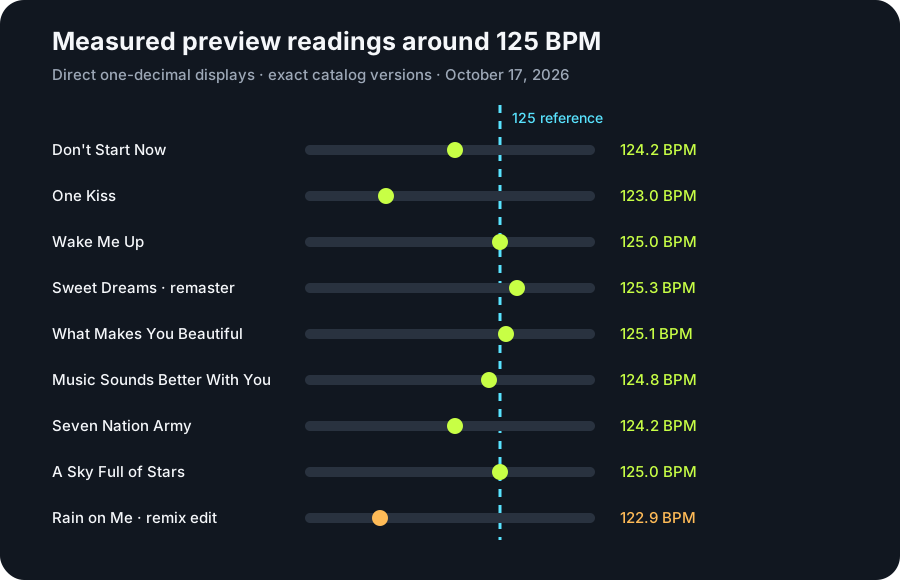
These nine exact catalog previews produced raw browser-tool readings from 122.9 to 125.3 BPM. The values stay unrounded and each row links to the version tested. They describe the available excerpt, not an entire commercial recording.
Raw BPM Finder displays for the accepted recording previews
A song title is not a measurement target by itself. The linked “Sweet Dreams” row is the 2005 remaster, “Music Sounds Better With You” is the radio edit, and “Rain on Me” is a named remix edit. This page keeps those labels beside the raw display so a different mix is not silently treated as the same audio.
The nine accepted rows form a narrow cluster, but they are not rounded to a shared label. “One Kiss” displayed 123.0 BPM while the “Sweet Dreams” remaster displayed 125.3 BPM. Both passed the stated screen; neither is rewritten as exactly 125.
Original comparison of the raw one-decimal displays. Every dot belongs to the linked version in the shortlist.
Three plausible numbers stayed off the page
The search for Katy Perry's “Firework” returned a Party Machine instrumental-version recording that displayed 125.0 BPM. The “Starships” search returned a Party Machine vocal-melody version at 125.0 BPM. The “Bulletproof” search returned Ian Asher's “Bulletproof (This Time Baby)” at 137.4 BPM. None of those results is the requested original artist recording, so all three remain in the screening file as exclusions.
This identity check is part of the result. A convenient number cannot repair a mismatched artist or version. It also explains why the list is shorter than the number of candidates tested.
Turn the reading into timing without inventing accuracy
At the reference rate, one beat interval is 60 ÷ 125 = 0.48 seconds, or 480 milliseconds. For the measured 124.2 BPM preview of “Don't Start Now,” the corresponding interval is 60,000 ÷ 124.2 = 483.1 milliseconds. That conversion is arithmetic based on the displayed reading; it is not a second audio measurement.
A BPM Finder may follow a strong recurring layer rather than the pulse a listener chooses for movement. When two pulse levels feel plausible, keep the raw display and state any half-time or double-time choice separately. No pulse conversion was needed for the nine rows on this page.
Use the number as a cue, not a pace guarantee
One step per counted beat at 125 BPM corresponds to a cadence of 125 steps per minute. It does not determine running speed. Pace also depends on measured step length, terrain, gait and the pulse level the runner follows.
With step length L meters, minutes per kilometer would be 1,000 ÷ (125 × L). We did not measure a runner or a step length, so this page does not turn a song reading into a personal training prescription.
Questions about the shortlist
Are these songs certified at exactly 125 BPM?
No. The page reports raw one-decimal displays from specific preview files inside a declared screening window. It does not certify a whole recording or round every value to 125.
Why include a remix?
The remix appears only because its exact catalog version is named and linked. The reading belongs to that remix edit, not automatically to the original release.
Can I check another recording?
Yes. Load a lawful local file into the BPM Finder. Compare its raw display with the pulse you hear, and keep the version name with the result.
Sources and measurement conditions
On October 17, 2026 in Shanghai time, each public Deezer catalog preview was fetched into memory and supplied through the browser file chooser to the unmodified Tap BPM Now BPM Finder in Chrome. The tool reported “Analysis complete” and displayed the one-decimal readings recorded here. No preview audio or lyrics are hosted on this page.
The available catalog files were approximately thirty seconds long. Their positions inside the complete recordings were not stated. This test did not establish full-song stability, intended beat level, preview-to-preview repeatability or the analyzer's error margin. The screening CSV preserves all source records, UTC measurement times, raw displays and inclusion decisions.