Eleven linked previews · measured October 19, 2026
135 BPM Songs: A Measured Preview List
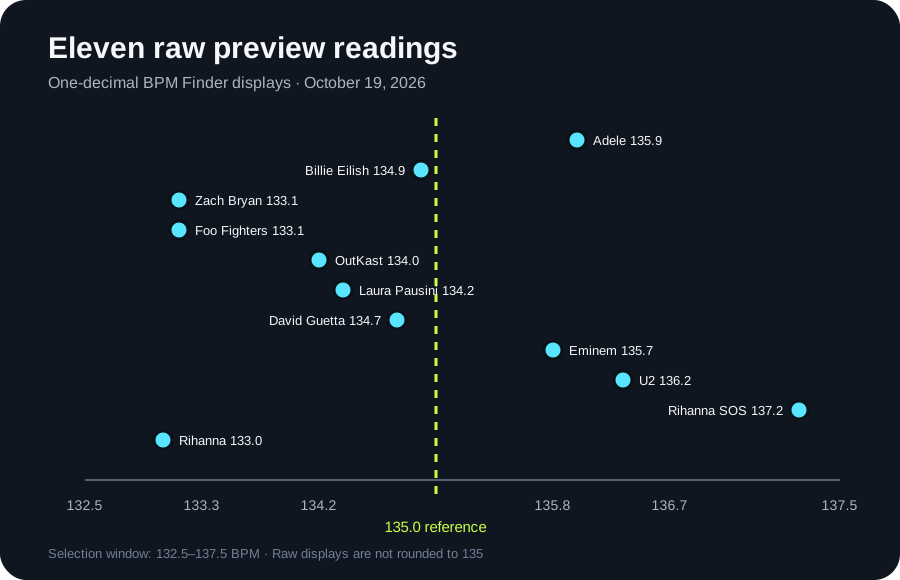
These eleven exact catalog previews produced raw BPM Finder readings from 133.0 to 137.2 BPM. Every value is the one-decimal browser display, not a number rounded to 135. Each link identifies the version tested; the result describes the available excerpt rather than a complete recording.
Raw BPM Finder displays for the accepted recording previews
The accepted previews span 4.2 BPM. “Shut Up and Drive” displayed 133.0 BPM, while the linked album version of “SOS” displayed 137.2 BPM. Both fit the declared window, and neither is relabeled as exactly 135.
That spread also changes beat spacing. The 133.0 display corresponds to 451.1 milliseconds per beat; 137.2 corresponds to 437.3 milliseconds. The difference is 13.8 milliseconds per beat, calculated from the two raw displays rather than inferred from a song database.
Original plot of the eleven raw one-decimal displays. The vertical reference marks 135 BPM; it does not overwrite any measurement.
Three candidates failed the screen
The Real McCoy album-version result displayed 131.9 BPM, outside the lower boundary. The available “Starry Eyes” preview displayed 166.6 BPM. The “Can't Hold Us” lookup resolved to a tribute recording rather than the requested artist version and displayed 145.9 BPM. All three stay in the downloadable record as exclusions.
Identity and result both matter. A familiar title is not enough when the available catalog object is a tribute, remix, remaster, live recording or another named version. Excluding mismatches keeps a convenient number from becoming a false claim.
Convert a measured reading into beat timing
At the 135 BPM reference, one beat interval is 60,000 ÷ 135 = 444.4 milliseconds. Adele's linked preview displayed 135.9 BPM, which gives 60,000 ÷ 135.9 = 441.5 milliseconds. The two numbers answer different questions: 444.4 ms describes the reference label, while 441.5 ms is arithmetic based on the measured preview.
The BPM Finder can follow the strongest repeating event in a preview rather than the pulse a listener chooses for movement. This page preserves the detector's direct display and applies no half-time or double-time conversion to the accepted rows.
What 135 BPM does and does not tell a runner
Counting one step on each beat gives a cadence of 135 steps per minute. It does not determine speed. With measured step length L meters, pace would be 1,000 ÷ (135 × L) minutes per kilometer.
No runner, step length, surface or gait was measured in this catalog test. The song list can provide a timing cue, but it cannot provide a personal pace or training limit.
Questions about these results
Are all eleven songs exactly 135 BPM?
No. They are exact linked recording previews whose direct displays passed a stated window around 135 BPM. The raw one-decimal values remain visible.
Why can a detector follow a different rhythmic layer?
An analyzer may lock onto whichever recurring events are strongest in the available excerpt. A listener may count a slower or faster pulse. Keeping the raw display, version and method together makes that ambiguity visible.
Can I test another version?
Yes. Load a lawful local file into the BPM Finder, record the version label and preserve the raw display before making any pulse interpretation.
Sources and measurement conditions
On October 19, 2026 in Shanghai time, each public Deezer catalog preview was fetched into memory and supplied through the browser file chooser to the unmodified Tap BPM Now BPM Finder in Chrome. The tool reported “Analysis complete” and displayed the one-decimal readings recorded here. No preview audio or lyrics are hosted on this page.
The public preview position inside each complete recording was not stated. This test does not establish whole-song tempo stability, intended beat level, repeatability across encodes or an analyzer error margin. The screening CSV preserves every source ID, UTC check time, raw display and inclusion decision.