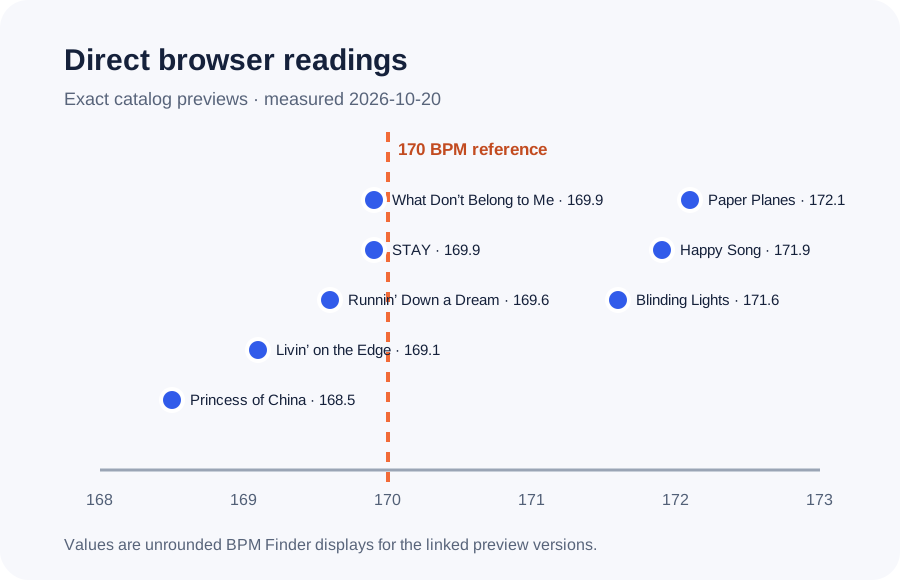
These eight exact catalog previews produced direct BPM Finder readings from 168.5 to 172.1 BPM. The first screen preserves every one-decimal result and names the version tested. The values describe the available excerpts, not an entire recording and not a database tempo copied from another list.
Direct BPM Finder displays for the accepted recording previews
The accepted previews span 3.6 BPM. The linked “Princess of China” radio edit displayed 168.5 BPM, while “Paper Planes” displayed 172.1 BPM. Both pass the declared window, and neither is relabeled as exactly 170.
That spread changes beat spacing. A 168.5 BPM display corresponds to 60,000 ÷ 168.5 = 356.1 milliseconds per beat. A 172.1 display corresponds to 348.6 milliseconds. The difference is 7.5 milliseconds per beat, calculated from the two browser results.
Original plot of the eight raw one-decimal displays. The vertical reference marks 170 BPM without replacing any measurement.
Why an 85.4 reading is not called 170.8
The “Cruel Summer” preview returned 85.4 BPM. Doubling that number gives 170.8 BPM, but 170.8 is arithmetic, not another analyzer result. This page uses a direct-result screen, so the track remains in the exclusions instead of being promoted by a convenient double-time interpretation.
The same boundary protects the list from silent corrections. A listener may choose a faster or slower pulse layer, but that choice must remain separate from the raw detector display.
Six candidates failed the declared screen
“Bad Romance” displayed 119.1 BPM; “Basket Case” displayed 175.3; “American Woman” displayed 167.4; and “Everywhere I Go” displayed 219.9. The “Do I Wanna Know” lookup resolved to an “Arctic Monkey” catalog recording rather than the requested Arctic Monkeys version and displayed 176.2 BPM. “Cruel Summer” produced the 85.4 result discussed above.
Every exclusion remains in the downloadable record with the exact catalog link, check time, raw display, and reason. A familiar title alone is not sufficient when the available item is a different artist, edit, compilation version, remix, or tribute.
Use a measured reading for timing, not a promise about pace
At the 170 BPM reference, one beat lasts 60,000 ÷ 170 = 352.9 milliseconds. The two 169.9 BPM previews correspond to 353.1 milliseconds per detected beat. These intervals can set a click track or editing grid without rounding the source reading to a whole-number label.
If a runner takes one step on every detected beat, 169.9 BPM becomes 169.9 steps per minute. Running pace still needs the runner’s measured step length. With step length L meters, pace is 1,000 ÷ (169.9 × L) minutes per kilometer. No stride length, distance, or runner performance was measured here.
How the preview checks were made
Open a public catalog record and identify the exact track version.
Supply its available preview to the site’s browser-local BPM Finder.
Preserve the one-decimal display without rounding or correcting its pulse layer.
Accept only direct displays inside the stated 167.5–172.5 window.
Keep every rejected candidate and its reason in the screening record.
The analyzer ran locally in installed Chrome. Preview audio was not uploaded to this site, retained in the published assets, or redistributed.
What this list does not establish
A catalog preview is only an available excerpt. Its position inside the full recording is not stated, and a song may change tempo or emphasize another rhythmic layer elsewhere. These readings therefore do not certify a canonical whole-song BPM or an accuracy margin for the detector.
The list also makes no claim that a song suits every runner, dancer, drummer, or listener. Version identity, audible subdivision, meter, stride, and personal comfort still matter.
Questions
Are all eight songs exactly 170 BPM?
No. The direct displays range from 168.5 to 172.1 BPM. The page keeps that spread visible instead of rounding every entry to the keyword.
Why are half-time and double-time candidates excluded?
This page’s declared rule uses direct browser displays. A multiplied or divided value may describe a useful pulse layer, but it is labeled as arithmetic and is not substituted for the raw result.
Can I reproduce the checks?
Yes. Use the linked catalog version, the browser-local BPM Finder, and the dated screening CSV. The exact public preview can change or disappear, so a later run should record its own date and result.