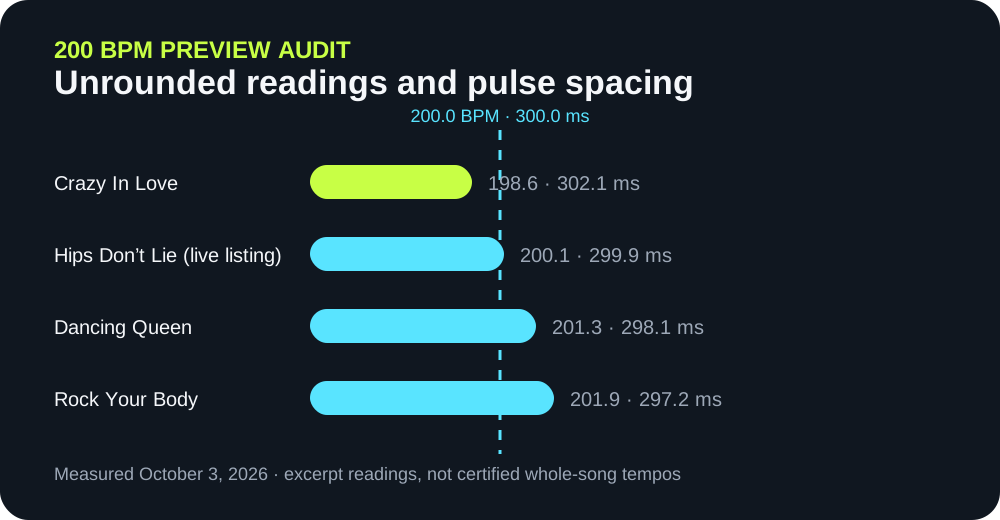
Start with these four measured preview excerpts: Beyoncé’s “Crazy In Love” at 198.6 BPM, Shakira’s anniversary live “Hips Don’t Lie” listing at 200.1 BPM, ABBA’s “Dancing Queen” at 201.3 BPM, and Justin Timberlake’s “Rock Your Body” at 201.9 BPM. These are unrounded tool displays for the linked excerpts, not claims that the complete recordings hold exactly 200 BPM.
Tap BPM Now preview measurements from October 3, 2026
The linked records identify the recording versions and available previews. The BPM values came from our October 3 browser-local BPM Finder run. Interval values use 60,000 ÷ raw BPM and are rounded to one decimal millisecond.
A 200 BPM reference is one pulse every 300 milliseconds
The reference calculation is 60,000 milliseconds ÷ 200 beats = 300 milliseconds per beat. The measured excerpts straddle that line: the 198.6 reading gives 302.1 milliseconds, while the 201.9 reading gives 297.2 milliseconds. The complete observed spread is 4.9 milliseconds per detected pulse.
Over three minutes, the same differences would accumulate to 4.2 fewer detected pulses for 198.6 BPM, 0.3 extra for 200.1, 3.9 extra for 201.3, and 5.7 extra for 201.9, if each measured pulse stayed constant. This is arithmetic from the excerpt readings, not a whole-song stability test.
Original interval comparison built from the retained unrounded readings. The center line marks exactly 200 BPM, or 300 milliseconds per beat.
Why the same excerpt can also be counted near 100 BPM
A detector may follow a fast recurring layer while a listener follows every second event. Dividing the four raw readings by two yields 99.3, 100.05, 100.65, and 100.95 BPM. That does not change the audio. It labels another possible counting level.
Use the 100 BPM comparison when you want the slower count. Use this page when you want the faster detected layer and its roughly 300-millisecond spacing. Neither page declares a canonical score tempo for the complete recording.
How to verify a 200 BPM passage
Open the exact recording version rather than substituting a remix, live take, or remaster.
Choose a steady passage and analyze a local file in the BPM Finder, or tap the fast layer in the Tempo Tapper.
Keep the unrounded reading and note whether you followed every event or every second event.
Compare a short run again in another section before treating the result as representative of the whole track.
The Shakira row is deliberately labeled as an anniversary live listing. Its result must not be transferred silently to the studio single. Deezer did not state where any preview begins within the complete recording.
Questions about 200 BPM songs
Are these songs exactly 200 BPM?
No. The displayed excerpt readings range from 198.6 to 201.9 BPM. The headline describes a narrow neighborhood around 200 rather than rounding every result to the same number.
Does 200 BPM mean 200 notes per minute?
No. It means 200 events at the chosen beat level. A recording can place several notes inside one beat or sustain a note across multiple beats.
Does the table cover each full song?
No. It records the available preview excerpt for each linked listing. Whole-song tempo changes, preview position, and analyzer error margin are not stated.
Measurement record and boundary
On October 3, 2026, ten lawful Deezer previews were selected in the live Tap BPM Now BPM Finder in Chrome. Four raw displays fell inside the declared 198–202 BPM screen and appear above; six others were excluded. Audio was processed locally and was not retained or published by this site. The source supplied the recording listings and previews, not the BPM figures.