Press Start for an 80 BPM click. Quarter-note beats are exactly 750 milliseconds apart. The control starts at 80 and remains adjustable for a slower count or a faster rehearsal pass.
BPM
Compare every interval
Tap against the 750 ms pulse
At 80 BPM, consecutive taps centered on the beat should be about 750 milliseconds apart. The recent-interval row keeps individual gaps visible beside the average.
Current tap BPM—
Average tap BPM—
Recent tap intervals
— ms
— ms
— ms
— ms
— ms
— ms
The 80 BPM interval grid
The quarter-note interval is 60,000 milliseconds divided by 80 beats, which equals 750 milliseconds. The other rows below multiply or divide that base interval, so their arithmetic remains visible.
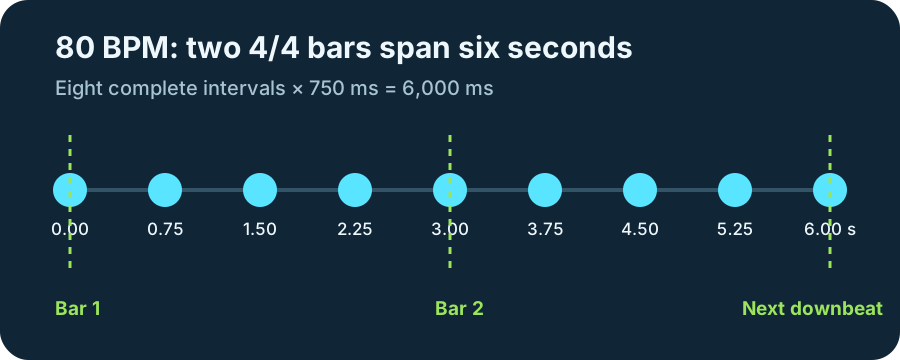
Two complete 4/4 bars span eight 750-millisecond intervals, or six seconds, from the first downbeat to the next.
Click value
Interval
Calculation from 80 BPM
Half note
1,500 ms
750 × 2
Dotted quarter
1,125 ms
750 × 1.5
Quarter note
750 ms
60,000 ÷ 80
Eighth note
375 ms
750 ÷ 2
Eighth-note triplet
250 ms
750 ÷ 3
Sixteenth note
187.5 ms
750 ÷ 4
A two-bar six-second audit
In 4/4, two full bars contain eight quarter-note intervals when you count from the first downbeat to the next downbeat after bar two. Eight intervals multiplied by 750 milliseconds equal 6,000 milliseconds, or six seconds.
Leave the tempo at 80, choose 4/4, and keep quarter notes selected.
Begin on an accented downbeat and count two complete bars.
Listen for the next accented downbeat as the endpoint. Counting only the eight sounded beats would omit the final interval.
A wall clock is only a rough playback comparison. Browser scheduling, the audio device, and the speaker each affect when the sound reaches you.
One pulse, three useful event rates
The quarter-note layer schedules 80 ÷ 60, or about 1.333 beat events per second. Eighth notes double the audible rate to about 2.667 clicks per second. Triplets produce exactly four clicks per second because each 750-millisecond beat is divided into three 250-millisecond gaps.
Use the triplet layer when you need three equal positions inside each beat, then return to quarter notes without touching the 80 BPM field. The added clicks change the guide density, not the underlying beat rate.
80 BPM metronome questions
How long is one beat at 80 BPM?
One quarter-note beat lasts 750 milliseconds because 60,000 milliseconds ÷ 80 beats = 750.
How long is one 4/4 bar at 80 BPM?
Four quarter-note intervals take three seconds: 4 × 750 milliseconds = 3,000 milliseconds.
Do eighth notes turn this into 160 BPM?
No. Eighth notes add a click every 375 milliseconds while the quarter-note pulse remains 80 BPM.
Why must I press Start first?
Browsers normally require a user action before starting or resuming an audio context. The Start button activates the local clock used for the click schedule.
Timing boundary
The interval, event-rate and bar-duration values above are transparent calculations from a selected 80 BPM value. They do not measure a performance, certify speaker latency, or prove that a recording remains at 80 BPM. Use the tap panel for your own input gaps and the BPM Finder for a browser estimate from a selected audio file.