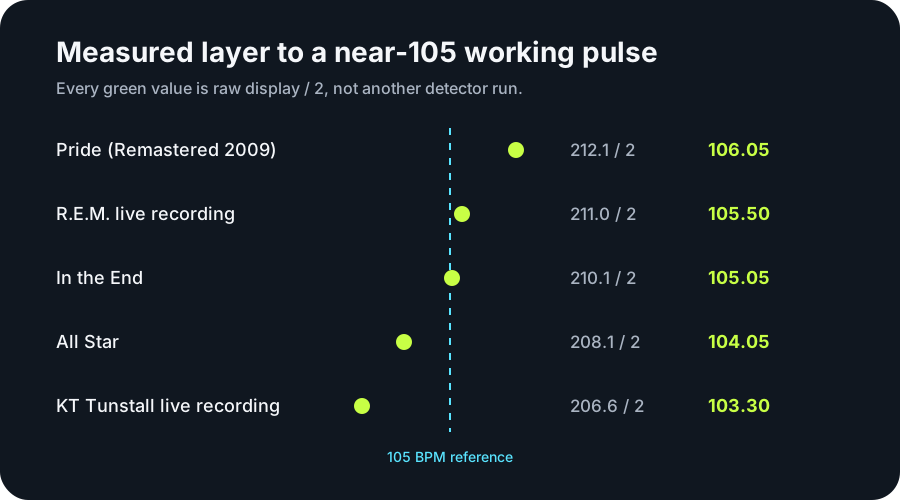
These linked recording previews produced raw BPM Finder displays from 206.6 to 212.1 BPM. Dividing the raw displays by two gives working pulse counts from 103.30 to 106.05 BPM. The list keeps each source measurement beside its arithmetic instead of rounding every recording to 105.
Exact catalog version, raw browser reading, and transparent half-time count
The list preserves the faster layer the detector found
The BPM Finder followed a recurring layer near 210 BPM in these excerpts. A listener can choose every second detected event as a slower working pulse near 105 BPM, but that counting choice does not alter the audio. The table therefore shows both layers and labels the slower number as arithmetic.
The widest pair in this shortlist is 206.6 and 212.1 BPM. Their half-time counts are 103.30 and 106.05 BPM, a span of 2.75 BPM. That spread is visible instead of being flattened into thirteen identical 105 labels.
Original data graphic separating measured detector output from half-time arithmetic.
One BPM difference changes the interval by milliseconds
A 105.05 BPM working pulse lasts 60,000 / 105.05 = 571.2 milliseconds per beat. The slow edge, 103.30 BPM, lasts 580.8 milliseconds; the fast edge, 106.05 BPM, lasts 565.8 milliseconds. Across this measured set, the beat interval changes by 15.0 milliseconds.
That interval calculation is useful for a metronome, an edit grid, or a practice loop. It is not proof that one count is musically correct. Meter, phrasing, and the listener's task still determine whether the faster or slower layer is more useful.
The evidence is version-specific
Each row names the exact catalog listing measured on October 22, 2026. Three rows are explicitly live versions, and one identifies a remaster. Those labels matter: a studio master, edit, remix, later live performance, or another excerpt can produce a different detector display.
Each complete available catalog preview was supplied to the site's browser-local BPM Finder. The catalog did not state where the excerpt begins inside the full recording. The page therefore describes the available preview, not an untested whole track, and it hosts neither audio nor lyrics.
Excluded results stop the title from becoming the answer
The same run also checked other catalog matches. A Rascal Flatts listing displayed 203.9 BPM, which gives 101.95 after division by two and fell below this page's 102.5-to-107.5 working window. A Cranberries listing displayed 165.0 BPM and did not produce a near-105 half-time option. An ABBA query returned a tribute-band catalog match, so it was excluded rather than presented as the intended artist.
Those exclusions show the boundary: a familiar title is not enough. The exact catalog match, raw display, and arithmetic all have to support the row.
Running pace still needs your measured step length
If one footfall lands on each 105.05 BPM working beat, cadence is 105.05 steps per minute. Counting both feet against the faster detector layer gives 210.1 step events per minute. These are different counting conventions attached to one measured pulse relationship.
Distance pace also requires step length. With step length L meters, pace is 1,000 / (105.05 x L) minutes per kilometer. No runner or stride length was measured here, so the song reading alone cannot supply a personal pace.
How to reproduce a row
Open the exact catalog listing linked in the table.
Supply the legally available preview or a file you own to the browser-local BPM Finder.
Record the one-decimal detector display, source version, and date without rounding toward the target phrase.
Divide that display by two and label the result as half-time arithmetic.
No. The direct displays range from 206.6 to 212.1 BPM. The near-105 values are explicit division by two.
Why keep one decimal place in the raw reading?
It prevents a target phrase from pulling a real result toward a convenient whole number and keeps the later calculation reproducible.
Does a half-time count make the recording slower?
No. The audio clock is unchanged. Half-time selects every second event in the faster recurring layer.
Can a later test disagree?
Yes. A different recording, excerpt, remaster, or analysis section can emphasize another pulse. Keep the exact source and date with every repeated test.