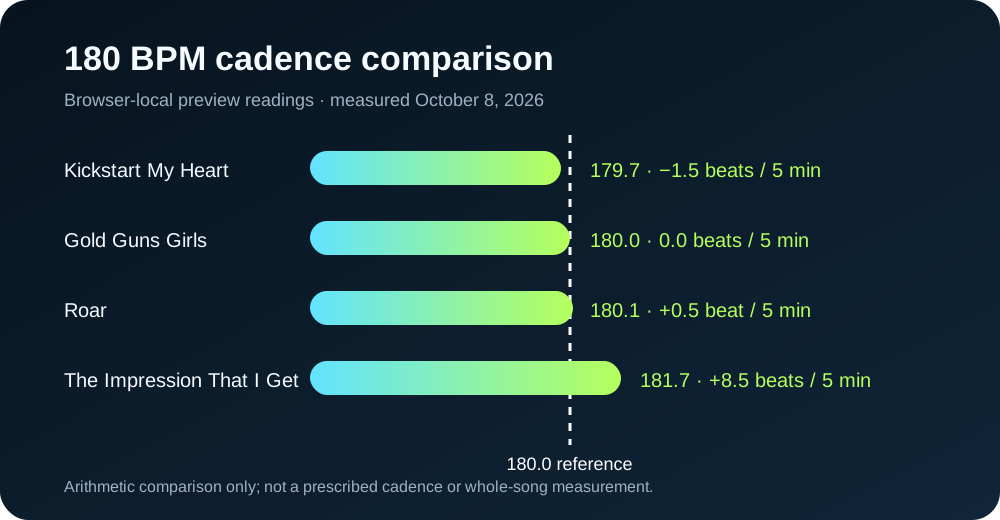
Start with these four measured previews: Metric’s “Gold Guns Girls” at 180.0, Katy Perry’s “Roar” at 180.1, Mötley Crüe’s “Kickstart My Heart” at 179.7, and The Mighty Mighty Bosstones’ “The Impression That I Get” at 181.7 BPM. One step per beat gives approximately the same number of steps per minute; two steps per beat uses the half-time value.
Tap BPM Now preview measurements from October 8, 2026
The source supplied the linked recording previews, not the BPM figures. Our local BPM Finder produced the displayed values from the available excerpts. “spm” is arithmetic shorthand for steps per minute, not a recommendation for your body or pace.
Match a cadence without changing the song data
Enter the step rate you already use. The matcher compares it with the four raw preview readings above and shows the nearest one-step-per-beat option. It also shows the half-time music value for two steps per beat.
At 180.0 steps per minute, “Gold Guns Girls” is the nearest measured preview at 180.0 BPM. A two-steps-per-beat cue would use 90.0 BPM.
What the four readings mean over five minutes
The comparison is transparent arithmetic: subtract 180 from each raw reading, then multiply that difference by five minutes. Metric’s 180.0 produces no beat-count difference from a 180 reference. “Roar” at 180.1 produces 0.5 extra beat over five minutes. “Kickstart My Heart” at 179.7 produces 1.5 fewer beats. The Bosstones preview at 181.7 produces 8.5 extra beats.
Those figures do not predict your pace, stride length, fatigue, or safety. They only describe how the measured excerpt’s repeating pulse would accumulate against a 180-beat reference if both stayed constant for five minutes.
Original cadence comparison built from the unrounded browser measurements; the center line is the 180 BPM reference.
One step per beat or two steps per beat?
At one step per beat, a 180.0 BPM pulse supplies 180 timing cues per minute. At two steps per beat, a 90.0 BPM pulse supplies 90 beats while the runner places two steps inside each beat interval. The step count can be the same even though the musical counting level is different.
This is why a playlist can mix music near 180 BPM with music near 90 BPM without claiming they are the same musical tempo. The relationship is exactly two to one. It does not decide which counting level feels natural for a particular recording or runner.
How to check a track before a run
Open the exact recording version and listen for a steady section.
Keep the unrounded display and note whether you counted the main beat or a half-time layer.
Compare the result with your observed cadence instead of forcing your movement to the title number.
Use headphones only where you can still monitor traffic, people, terrain, and other hazards. A music-tempo page is not a substitute for training or medical advice.
Questions about 180 BPM running music
Are all four songs exactly 180 BPM?
No. The raw preview displays range from 179.7 to 181.7. The page preserves those values rather than rounding every candidate to the headline.
Does the reading cover the whole song?
No. It describes the publicly available preview excerpt and the specific linked release listing. The preview start position in the full recording, whole-song stability, and analyzer error margin are not stated.
Is 180 steps per minute a universal target?
This page does not set a target. It helps compare recorded music tempo with a cadence you have already observed. Individual movement and training decisions are outside the measurement.
Measurement record and boundaries
On October 8, 2026, each linked preview completed analysis in the live Tap BPM Now BPM Finder in Chrome. The tool ran locally on the device; audio was not uploaded by this site. The exact track IDs identify the listings. The four raw values are reused from that dated record, not presented as new measurements. Audio, artwork, and lyrics are not hosted here.
For the broader non-running measurement table and rejected candidates, see 180 BPM Songs.