What the BPM number counts
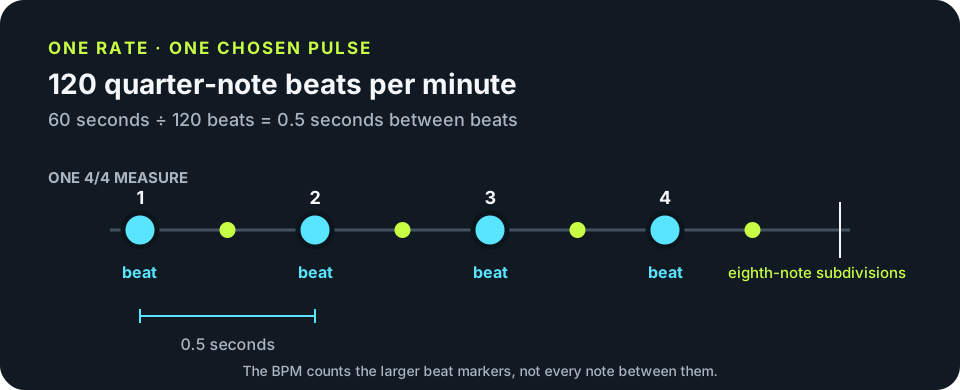
A beat is the recurring pulse a listener or musician follows. BPM counts that pulse against a minute. A song can contain many notes between beats, so a fast melody does not automatically mean the tempo is high. Likewise, a measure may contain several beats, but BPM is not a count of measures per minute.
To interpret a printed tempo mark, check which note value receives the beat. A score might assign the pulse to a quarter note, half note, or another value. The notation and musical context establish the beat unit; the BPM number gives its rate. The Texas A&M Open Library music-theory text explains how a time signature identifies beats per measure and the note value assigned to a beat.
BPM, tempo, and meter mean different things
Tempo is the speed of the beat. BPM is one numeric way to state that speed. Meter describes the repeating grouping of beats into measures and the usual divisions within those beats. A 4/4 passage with a quarter-note beat groups four pulses into a measure; changing the accents or subdivision can change the feel without changing the beat rate.
This distinction matters when someone asks for the definition of tempo or the tempo meaning of a marking: tempo answers “how quickly does the chosen beat move?”, while meter answers “how are beats grouped?” The University of Puget Sound’s music-theory section on meter makes this separation explicit and also describes simple and compound beat divisions.
Why the same BPM can feel unlike the same song
The number alone leaves out accent, subdivision, articulation, and the layer of the music you chose to follow. At the same BPM, a steady quarter-note pulse can sit under eighth-note motion, rests, or syncopated phrases. The written rate can stay fixed while those parts make the music feel more spacious, busier, or differently grouped.
There can also be more than one plausible pulse level. If a listener follows every other perceived beat, the count is half the faster pulse; if the listener follows the in-between beats, the count is double the slower pulse. These are alternative ways of counting a pulse, not evidence by themselves that the recording changed speed. The UC Irvine Computer Audio and Music Programming note connects beats per minute to the duration of each beat interval.
How to read a song BPM without mixing up the pulse
- Listen for the recurring pulse that feels stable across the phrase, rather than tapping every note.
- Notice where stronger accents repeat; they can reveal the measure grouping, but accents do not change the BPM by themselves.
- Choose the beat level you mean before comparing a displayed number with sheet music or another track.
- If you want to test your own pulse, use the tempo tapper. For a displayed tempo from a selected local audio file, use the song BPM finder; compare its reading with the pulse you intended to count.
These checks keep a song BPM reading tied to a musical pulse instead of treating it as a complete description of rhythm. The City University of New York’s rhythm chapter also distinguishes tempo from the character created by rhythm and meter.
BPM meaning questions
What do the letters BPM mean?
BPM means beats per minute: the number of chosen musical beats in one minute. The beat unit must be understood before comparing two readings.
Is BPM the same as tempo?
BPM is a numeric expression of tempo. Tempo can also be indicated with a general direction such as a slow or fast marking, while BPM gives a specific rate.
What does 60 BPM mean?
It means one counted beat per second: 60 seconds in a minute divided by 60 beats. That statement refers to the selected beat, not every note or sound.
Does BPM count all the notes in a song?
No. BPM counts the chosen pulse. Notes can subdivide or extend across beats, and the meter groups beats into measures.
References for the musical terms
- University of Puget Sound, Section 4.4: Meter — beat, tempo, meter, and beat division.
- Texas A&M Open Library, Steps to Music Theory: Simple Meters — time signatures, beat units, and tempo markings.
- UC Irvine, Computer Audio and Music Programming: “It’s About Time” — BPM and beat-interval arithmetic.
- CUNY BMCC, Understanding Music: Rhythm — tempo, rhythm, and musical character.
To hear a steady reference pulse, open the online metronome. To compare a tapped interval with a BPM value, use the BPM and milliseconds calculator.